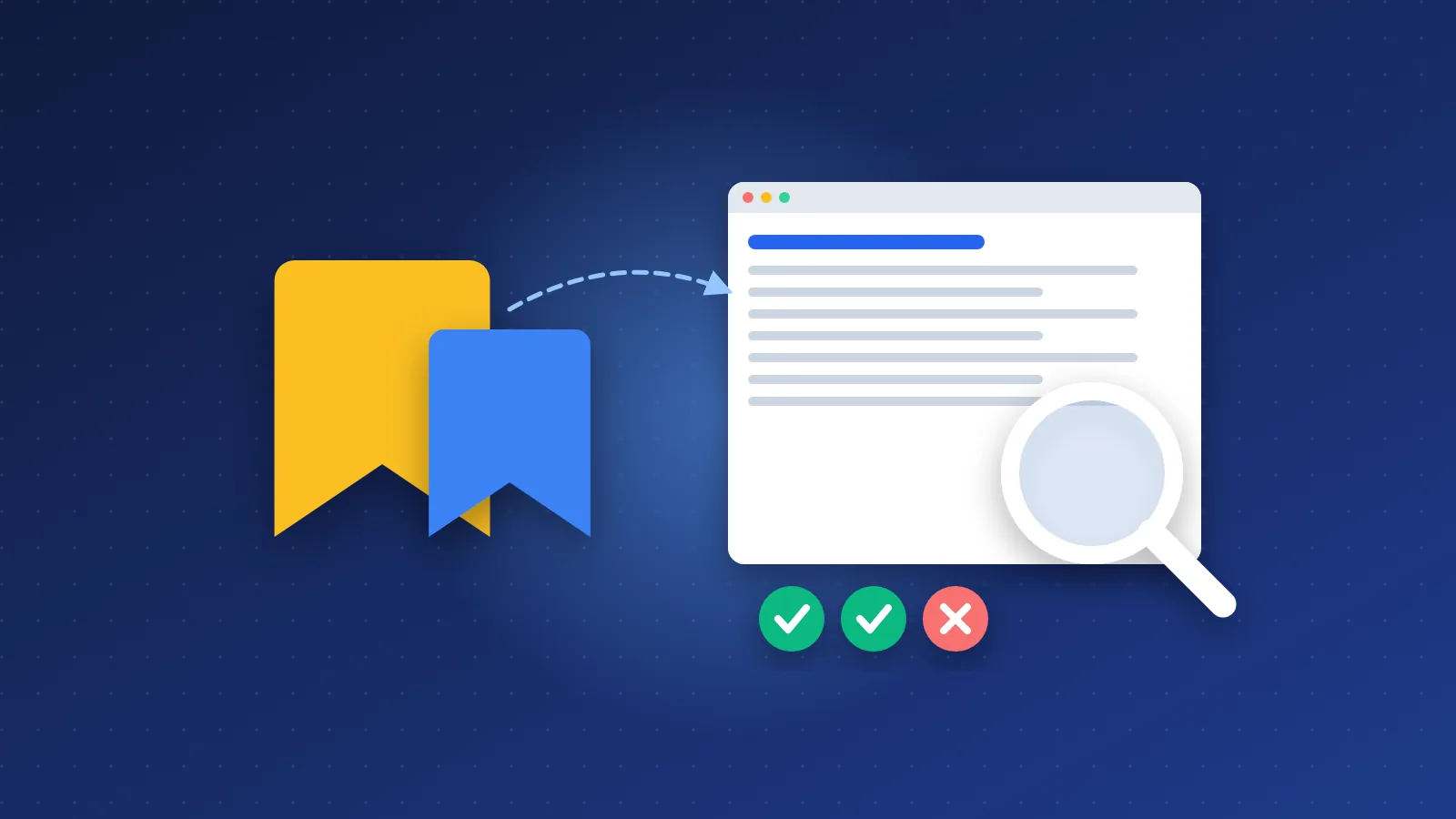
Social bookmarking sites that still get indexed are the ones with a live community, real moderation and public bookmark pages that Google can crawl. On most old "PR9 bookmarking lists", the majority of bookmark pages never make it into Google's index at all. The only way to know which sites work for you is to bookmark one URL, wait a few weeks and check each bookmark page yourself.
This guide explains why so many bookmarks vanish, gives you a simple 30-day method to test any list, and shows how to write a bookmark that has a fair chance of being indexed.
What is a social bookmarking site?
A social bookmarking site lets you save a web page publicly, add a title, a short description and tags, and share it with other users. Each saved page usually gets its own URL on the bookmarking site. That page is what we call the bookmark page.
Two more terms you need:
- Indexed means Google has crawled the bookmark page and stored it, so it can appear in search results.
- Backlink means a link from another site to yours. A bookmark page carries a backlink to the URL you saved. If you are new to links, read our beginner guide to backlinks first.
Why do most bookmarking links never get indexed?
Google says plainly that it "doesn't guarantee that it will crawl, index, or serve your page", and low-quality or duplicate content is one of the common reasons a page stays out. Bookmark pages hit both problems at once.
- Thin pages. A bookmark page is often a title, two lines of text and a link. There is little for Google to keep.
- Duplicates. When someone posts the same title and description on 50 sites, Google groups the near-identical pages and picks one, or none.
- Spam-filled sites. Many old bookmarking scripts were abandoned years ago. They are full of auto-posted junk, and Google crawls them rarely.
- Deep pages. New bookmarks sit far from the home page. If nothing links to them, crawlers may never find them.
- Removed posts. Active sites delete low-effort bookmarks. Dead sites disappear completely.
Also keep expectations clear about the link itself. Most bookmarking platforms mark user links as nofollow or ugc. Google's own documentation recommends the ugc value for user-generated links and notes that links with these attributes will generally not be followed. So a bookmark is mainly a discovery and traffic tool, not a ranking boost.
How to test a bookmarking list yourself (20 sites, one URL, 30 days)
You do not need paid tools for this. You need a spreadsheet and some patience.
- Pick one URL. Choose a real, useful page on your site, such as a guide or a resource page. Do not use your home page.
- Pick 20 sites. Start from a maintained list such as our social bookmarking sites list. Skip any site that will not load, has no recent posts, or shows obvious spam on the front page.
- Write a unique bookmark for each site. Same URL, but a different title and description each time (more on this below).
- Log everything. In your sheet, record the site name, the bookmark page URL, the date posted and the link type (follow, nofollow or ugc). You can see the link type by right-clicking the link and choosing "Inspect".
- Check on day 7, day 14 and day 30. Search Google for the exact bookmark page URL, or use
site:plus the bookmark URL. Note "indexed", "not indexed" or "removed".
One limit to know: Google Search Console's URL Inspection tool only works for URLs inside a property you own, so you cannot use it on bookmark pages hosted on other sites. A manual search is the practical check.
How to read your results
After 30 days, sort your sheet into three groups. The table below explains what each result usually means and what to do next.
| Result after 30 days | What it usually means | What to do |
|---|---|---|
| Indexed | The site is crawled often and the page had enough content to keep | Keep the site on your shortlist and use it again with fresh, unique bookmarks |
| Not indexed | Low crawl rate, thin page, or the site is ignored by Google | Re-check at day 60; drop the site if still missing |
| Removed | Moderators deleted the post, or the site went offline | Check the site's rules; drop it if it is dead |
As a rough estimate, on a random old list you should expect only a minority of bookmark pages to be indexed after a month. On a hand-picked list of active sites, the share is typically much better. Your own sheet is more reliable than any number you read online, because sites change fast.
How do you make a bookmark worth indexing?
Google keeps pages that add something. Treat each bookmark as a tiny piece of content, not a link drop.
- Title: write it for humans. Say what the page helps with, for example "Free checklist for submitting a site to web directories". Do not paste the same keyword title everywhere.
- Description: write 2 to 4 original sentences. Explain who the page is for and one useful thing they will learn. Around 40 to 80 words is a good target.
- Tags: use 3 to 5 relevant tags that match the site's existing categories. Ten random tags look like spam.
- Profile: fill in your profile, add a real avatar and save a few useful pages from other sites too. Accounts that only post their own links get removed faster.
- Timing: spread your bookmarks over days or weeks instead of posting everything in one hour.
Social bookmarking sites that still get indexed: what to use
Instead of a fixed list that goes stale, use these signs to choose sites. A bookmarking site is worth your time when:
- the front page shows posts from the last few days, not the last few years;
- bookmark pages are public and load without a login;
- other users comment, vote or follow, so there is a real audience;
- moderators remove spam, which you can see by how clean the latest posts are;
- a Google search for the site's domain shows recent bookmark pages, not only the home page.
Large, active platforms such as Pinterest, Reddit, Diigo and Pearltrees are good candidates to test first, but each has its own rules. Reddit, for example, punishes pure self-promotion, so share only where your page truly answers a community question. Smaller niche bookmarking sites can work too if they pass the checks above.
If you want more link sources that follow the same "quality over volume" idea, compare bookmarking with our free directory list. A well-run directory listing often lasts longer than a bookmark.
The short version: social bookmarking sites that still get indexed are active, moderated and crawled often, and the only reliable way to find them is your own 30-day check. Write unique, helpful bookmarks, track every page in a sheet, and keep only the sites that prove themselves.
Frequently asked questions
Do social bookmarking backlinks still help SEO?
They help a little with discovery and can send some referral traffic. Most bookmarking links are nofollow or ugc, so they rarely pass ranking value on their own. Use them as a small part of a wider link plan, not as the plan.
How long does it take for a bookmark page to get indexed?
On active sites it can happen within a few days. On slow or neglected sites it can take weeks or never happen. That is why checking at day 7, 14 and 30 gives you a clear picture.
Is it safe to post the same bookmark on many sites?
Posting identical text everywhere creates duplicate pages that Google tends to ignore, and it looks spammy to moderators. Write a fresh title and description for each site. Fewer, better bookmarks are safer and more useful.